

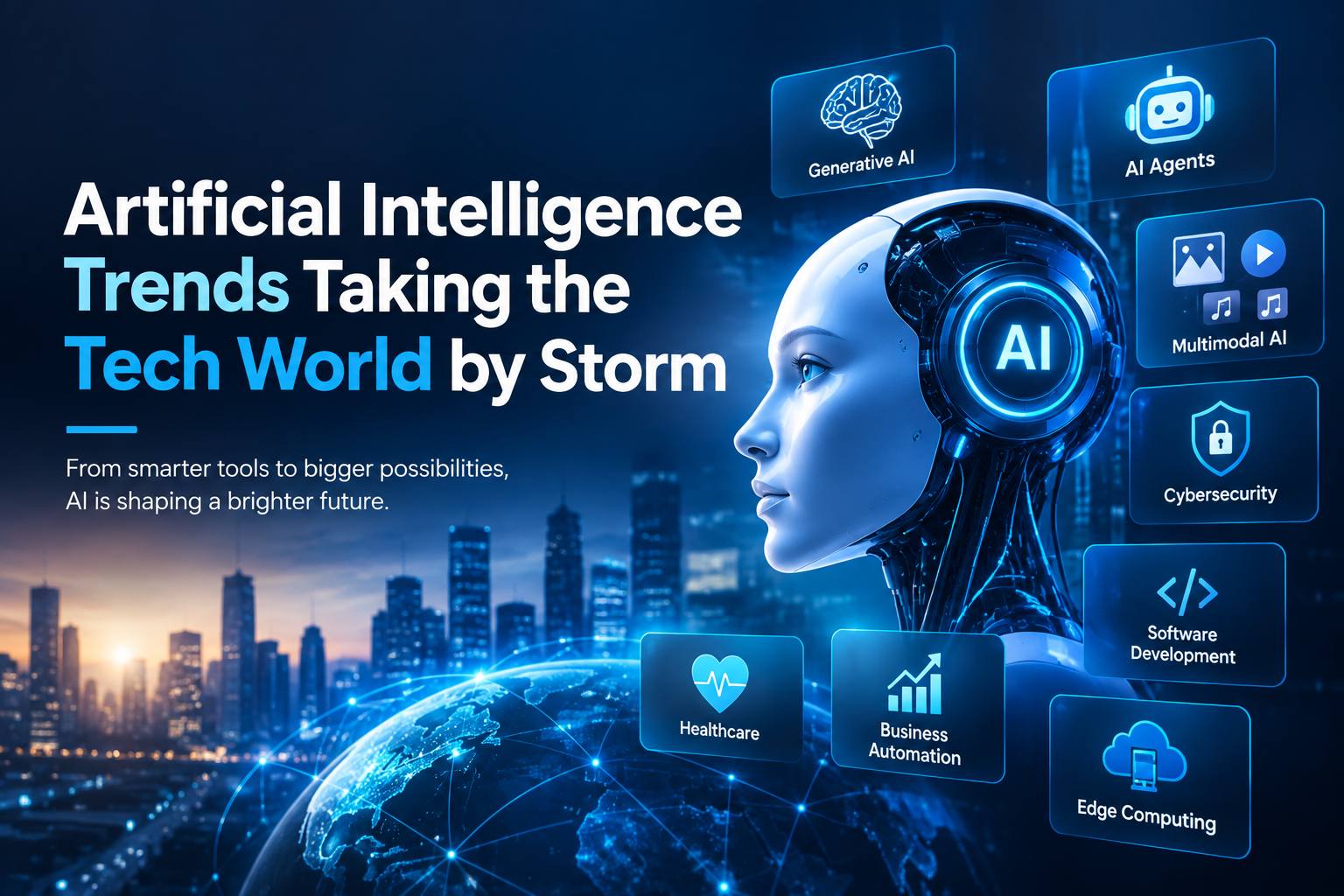
Artificial intelligence has become one of the biggest forces shaping the technology industry. From smart assistants and automated business systems to advanced software and personalized digital experiences, AI continues to influence how people work, communicate, and use technology.
In 2026, artificial intelligence trends are moving beyond basic automation. New AI capabilities are improving productivity, cybersecurity, software development, healthcare technology, business operations, and digital content. As these innovations continue, AI is becoming a central part of modern technology.
Read More: 10 Emerging Technologies Set to Shape the Future
Generative AI Continues to Evolve
Generative AI remains one of the most important artificial intelligence trends in 2026. Modern AI systems can create text, images, videos, audio, software code, and other digital content within seconds. Businesses are using these tools to support marketing, customer service, research, and content production.
The technology is also becoming more accurate and useful. Better reasoning, improved context understanding, and stronger multimodal capabilities allow AI systems to handle more complex tasks. This growth is making generative AI valuable across different industries.
AI Agents Are Changing Digital Work
AI agents are becoming a major technology trend as companies look for systems capable of completing tasks with less human intervention. Unlike traditional chatbots, AI agents can plan actions, use digital tools, analyze information, and complete multi-step workflows.
Businesses can use AI agents for research, scheduling, customer support, data analysis, software development, and administrative work. As agent technology develops, organizations are exploring new ways to combine human expertise with automated digital workers.
Multimodal AI Gains Momentum
Multimodal AI can process different types of information, including text, images, audio, video, and other data. This capability allows AI systems to understand information in a way that is closer to real-world human interaction.
Multimodal technology is creating new possibilities for education, customer service, accessibility, entertainment, and business applications. Users can communicate with AI through multiple formats instead of relying only on written prompts.
AI-Powered Cybersecurity
Cybersecurity is another area experiencing major AI-driven changes. Security teams are using artificial intelligence to detect unusual activity, identify potential threats, analyze large amounts of security data, and respond to incidents faster.
AI can continuously monitor digital environments and recognize patterns that may indicate suspicious behavior. At the same time, cybercriminals are also using AI for more sophisticated attacks, making advanced security systems increasingly important for businesses and organizations.
AI in Software Development
Artificial intelligence is transforming software development by helping programmers write, review, test, and improve code. AI coding assistants can generate code suggestions, explain technical concepts, identify errors, and support developers during different stages of development.
This trend is helping development teams reduce repetitive work and focus more attention on design and problem-solving. Human developers remain important for reviewing AI-generated code, managing architecture, and making critical technical decisions.
Smaller and More Efficient AI Models
AI development is not focused only on larger models. Smaller AI models are gaining attention because they can deliver useful performance while requiring fewer computing resources.
Efficient models can operate on smartphones, laptops, edge devices, and other hardware. This creates opportunities for faster applications, improved privacy, reduced cloud dependency, and lower operating costs.
Key advantages include:
- Faster AI processing
- Lower computing requirements
- Greater privacy for local data
- Better support for edge devices
AI-Powered Personalization
Personalization is becoming more advanced as AI systems analyze user behavior and preferences. Online platforms can use AI to recommend products, suggest content, customize search results, and improve digital experiences.
Modern personalization can go beyond basic recommendations. AI can understand patterns across different interactions and provide experiences that are more relevant to individual users.
AI in Healthcare Technology
Healthcare technology is also benefiting from artificial intelligence. AI systems can assist with medical research, image analysis, patient monitoring, drug discovery, and administrative processes.
These technologies are designed to support healthcare professionals rather than replace them. Human expertise, clinical judgment, privacy, safety, and regulatory oversight remain essential when AI is used in healthcare environments.
AI and Edge Computing
Edge AI combines artificial intelligence with local computing. Instead of sending every piece of data to a remote cloud server, certain AI tasks can be processed directly on devices.
This approach can reduce latency and improve responsiveness. Edge AI has applications in smart cameras, industrial equipment, connected vehicles, smartphones, robotics, and smart home technology.
Responsible AI Becomes More Important
As artificial intelligence becomes more powerful, responsible AI development is receiving greater attention. Companies are focusing on transparency, privacy, security, reliability, and responsible data usage.
Organizations are also developing policies for AI governance and human oversight. Responsible AI can help businesses reduce risks while creating systems that users can understand and trust.
Important areas include:
- Data privacy and security
- AI transparency
- Human oversight
- Bias and fairness
- Responsible data usage
AI Transforming Business Operations
Businesses across industries are adopting AI to improve efficiency and decision-making. Artificial intelligence can analyze large datasets, automate repetitive processes, support customer interactions, and help companies identify market patterns.
Small businesses can also benefit from accessible AI tools. From automated communication to data organization and content creation, AI is becoming part of everyday business workflows.
The Future of Artificial Intelligence
The future of AI will likely involve deeper integration between intelligent software, connected devices, cloud platforms, and human workflows. AI will increasingly operate in the background, helping people complete tasks and make sense of complex information.
The biggest shift may be from AI as a standalone tool toward AI as an integrated technology layer. As models become more capable and efficient, their influence will continue expanding across the technology landscape.
Frequently Asked Questions
What are the major AI trends in 2026?
Major AI trends include generative AI, AI agents, multimodal systems, edge AI, AI cybersecurity, and smaller efficient models.
How is generative AI changing technology?
Generative AI helps create text, images, videos, audio, and code while improving productivity across businesses and digital platforms.
What are AI agents?
AI agents are intelligent systems that can plan tasks, use digital tools, analyze information, and complete multi-step workflows with limited human input.
Why is multimodal AI important?
Multimodal AI can understand text, images, audio, and video, creating more natural and flexible interactions between people and technology.
How is AI improving cybersecurity?
AI can detect unusual activity, identify potential threats, analyze security data, and help security teams respond to attacks more quickly.
Is AI transforming software development?
Yes. AI coding tools can assist with code generation, debugging, testing, documentation, and repetitive development tasks.
What does the future of artificial intelligence look like?
AI is expected to become more integrated into software, devices, business systems, healthcare, cybersecurity, and everyday digital experiences.
Conclusion
Artificial intelligence trends are rapidly changing the tech world in 2026. Generative AI, AI agents, multimodal systems, cybersecurity, software development, edge computing, and responsible AI are creating new opportunities across industries.
As technology continues to evolve, businesses and users will need to understand both the benefits and challenges of AI. The combination of human creativity and intelligent technology is likely to remain a major force behind future digital innovation.

1 Comment
Pingback: Top Tech Innovations Changing Everyday Life in 2026