
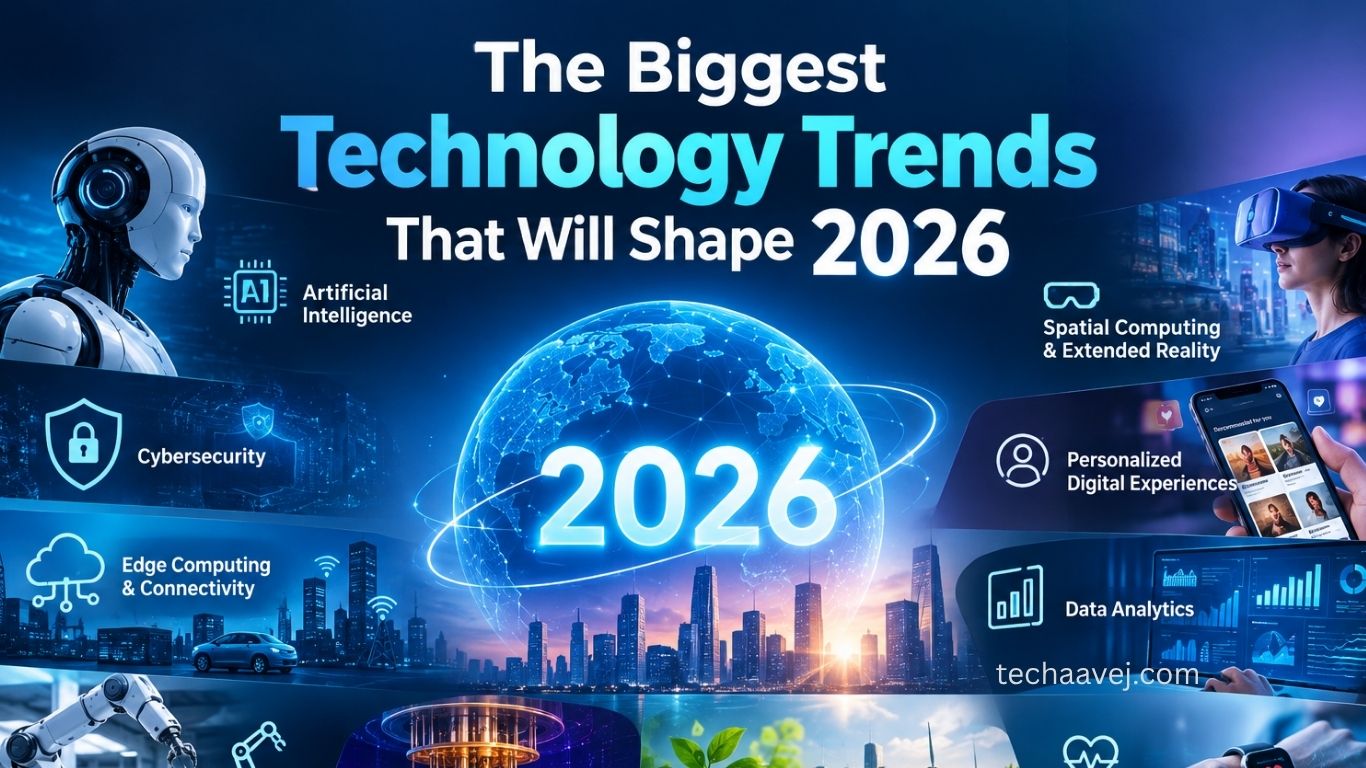
Technology continues to evolve at an extraordinary pace, changing how people work, communicate, shop, travel, and manage everyday life. As businesses and consumers enter a more digitally connected era, emerging technologies are becoming practical tools rather than distant concepts. From artificial intelligence and automation to cybersecurity and smart devices, several innovations are expected to have a major influence throughout 2026.
The biggest technology trends shaping 2026 will focus on smarter systems, greater automation, stronger digital security, and more personalized experiences. Companies that understand these developments early can improve efficiency, reduce costs, and create better products and services. At the same time, consumers will gain access to technologies designed to make everyday tasks faster, easier, and more convenient.
Read More: The Biggest Technology Trends to Watch in 2026
Artificial Intelligence Becomes More Autonomous
Artificial intelligence will remain one of the most influential technology trends in 2026. However, the focus is shifting from simple AI chatbots toward systems capable of understanding goals, planning tasks, and completing multiple steps with limited human intervention. AI agents are expected to become increasingly useful across business operations, customer support, research, software development, and content creation.
Generative AI will also become more integrated into everyday software. Instead of opening a separate AI application, users will increasingly find intelligent features built directly into productivity platforms, search engines, smartphones, and business systems. This deeper integration will make AI more accessible while changing how people interact with digital tools.
Key developments include:
- AI agents that can perform multi-step tasks
- More personalized generative AI experiences
- AI-powered business and productivity software
- Greater integration of AI into smartphones and computers
The Rise of AI-Powered Automation
Automation is moving beyond repetitive industrial tasks and entering professional and administrative environments. In 2026, organizations will increasingly use AI-powered automation to manage scheduling, data analysis, customer communication, document processing, and routine decision-support activities. This will allow employees to spend more time on creative and strategic responsibilities.
Small businesses are also likely to benefit from affordable automation platforms. Instead of requiring large technical teams, companies can use ready-made tools to automate marketing, sales, customer service, and internal workflows. The result could be higher productivity without requiring businesses to dramatically increase their workforce.
Cybersecurity Becomes More Intelligent
As technology becomes more connected, cybersecurity threats are becoming more sophisticated. Cybercriminals can use AI to create convincing phishing messages, automate attacks, and identify vulnerabilities more quickly. Because of this, organizations will need stronger security strategies that combine traditional protection with intelligent threat detection.
AI-powered cybersecurity systems can monitor large volumes of activity and identify unusual behavior in real time. Businesses will increasingly focus on continuous monitoring, identity protection, secure access, and rapid response. Cybersecurity will no longer be viewed only as an IT responsibility but as an essential part of overall business strategy.
Important security priorities for 2026 include:
- AI-based threat detection and monitoring
- Stronger identity and access management
- Zero-trust security strategies
- Protection against AI-generated scams and phishing
Edge Computing and Faster Digital Experiences
The growth of connected devices is creating enormous amounts of data. Sending all of this information to distant cloud servers can create delays and increase network demands. Edge computing addresses this challenge by processing more data closer to where it is generated, helping applications respond faster.
This technology will be particularly valuable for smart factories, autonomous systems, healthcare devices, connected vehicles, and other applications where real-time decisions matter. As 5G and other high-speed networks continue to expand, edge computing can help create faster and more responsive digital experiences.
The Expansion of Smart Devices
Smart technology will continue moving beyond smartphones and smart speakers. In 2026, connected appliances, wearable devices, vehicles, home security systems, and workplace equipment will become increasingly intelligent. These devices will collect and analyze information to provide more personalized and automated experiences.
The development of smarter ecosystems will also improve communication between devices. Instead of operating independently, connected products can work together through shared platforms and intelligent software. This could make homes, offices, and industrial environments more efficient while reducing the amount of manual control required.
Robotics Enters More Industries
Robotics is another major technology trend expected to accelerate in 2026. While robots have traditionally been associated with manufacturing, modern systems are becoming more flexible and capable of operating in warehouses, hospitals, retail environments, agriculture, and logistics.
Advances in artificial intelligence, sensors, computer vision, and machine learning are helping robots understand their surroundings more effectively. Businesses are particularly interested in robotics because these systems can perform repetitive or physically demanding tasks while supporting human workers and improving operational efficiency.
The Growth of Sustainable Technology
Environmental concerns are influencing the development of new technologies. Companies are investing in energy-efficient data centers, renewable energy systems, electric transportation, advanced batteries, and technologies designed to reduce waste. Sustainable technology will increasingly become an important part of both corporate strategy and product development.
Artificial intelligence and other computing technologies require significant energy, making efficiency increasingly important. Innovations in chip design, cooling systems, renewable power, and data-center management can help reduce the environmental impact of digital infrastructure while supporting continued technological growth.
Major areas of sustainable technology include:
- Energy-efficient computing and data centers
- Advanced battery technology
- Electric and intelligent transportation
- Smart energy management systems
Quantum Computing Moves Toward Practical Uses
Quantum computing remains an emerging field, but 2026 could bring further progress toward practical applications. Unlike conventional computers, quantum machines use quantum principles to process certain types of problems in fundamentally different ways. This could eventually transform areas such as materials science, drug discovery, optimization, and advanced simulation.
Quantum computing is not expected to replace traditional computers in everyday tasks. Instead, its potential lies in solving specialized problems that are extremely difficult for conventional systems. Continued research, improved hardware, and better quantum algorithms could bring the industry closer to useful commercial applications.
Extended Reality Creates New Experiences
Extended reality, including virtual reality, augmented reality, and mixed reality, is expected to continue developing in 2026. Improvements in hardware, displays, sensors, and spatial computing are making immersive experiences more practical and comfortable for users.
Businesses are exploring extended reality for training, education, product demonstrations, remote collaboration, design, and entertainment. Instead of being limited to gaming, immersive technology is becoming a broader digital platform that can change how people learn, work, and interact with information.
Cloud Technology Becomes More Flexible
Cloud computing will remain a foundation of modern digital infrastructure, but organizations will increasingly use hybrid and multi-cloud strategies. Businesses want the flexibility to combine private infrastructure, public cloud services, edge computing, and specialized platforms based on their individual requirements.
Cloud providers are also integrating more artificial intelligence capabilities into their services. This will make it easier for organizations to build intelligent applications without developing every component from scratch. As a result, cloud technology will continue supporting innovation across businesses of different sizes.
What These Technology Trends Mean for Businesses
The technology trends of 2026 will create both opportunities and challenges for businesses. Organizations that adopt useful technologies strategically can improve productivity, strengthen security, understand customers better, and respond more quickly to changing market conditions.
However, adopting every new technology is not necessarily the right approach. Businesses should focus on solutions that address genuine problems and provide measurable value. Employee training, data protection, ethical AI use, and long-term planning will be just as important as the technology itself.
Businesses should focus on:
- Identifying technologies that solve real operational problems
- Training employees to work effectively with new tools
- Strengthening cybersecurity and data protection
- Measuring the business value of technology investments
The Future of Technology in 2026
The biggest technology trends that will shape 2026 point toward a future that is more intelligent, automated, connected, and personalized. Artificial intelligence will influence nearly every major digital sector, while robotics, edge computing, cybersecurity, sustainable technology, and immersive experiences will continue expanding their roles.
Ultimately, the most important development will not be a single device or invention. It will be the growing integration of multiple technologies into everyday systems. Businesses and individuals that remain adaptable, understand emerging opportunities, and use technology responsibly will be better prepared for the rapidly changing digital landscape.
Frequently Asked Questions
What is the biggest technology trend in 2026?
AI is one of the biggest technology trends, driving automation and smarter digital tools.
How will AI impact businesses in 2026?
AI will automate tasks, improve productivity, and support faster decision-making.
Why is cybersecurity important in 2026?
Growing digital threats make stronger cybersecurity essential for protecting data and systems.
Will robotics grow in 2026?
Yes, robotics is expected to expand across manufacturing, healthcare, logistics, and other industries.
What is the role of quantum computing?
Quantum computing may help solve complex problems in science, medicine, and technology.
How will technology become more sustainable?
Companies are developing energy-efficient systems, advanced batteries, and cleaner technologies.
Why are 2026 technology trends important?
They will influence how businesses operate and how people work, communicate, and use digital services.
Conclusion
The biggest technology trends shaping 2026 are creating a future that is smarter, faster, more connected, and increasingly automated. Artificial intelligence, robotics, cybersecurity, edge computing, sustainable technology, quantum computing, and extended reality are all opening new opportunities for businesses and consumers. These innovations are not only changing how technology works but also transforming how people live and work.

1 Comment
Pingback: To Emerging Technologies Every Business Should Watch