
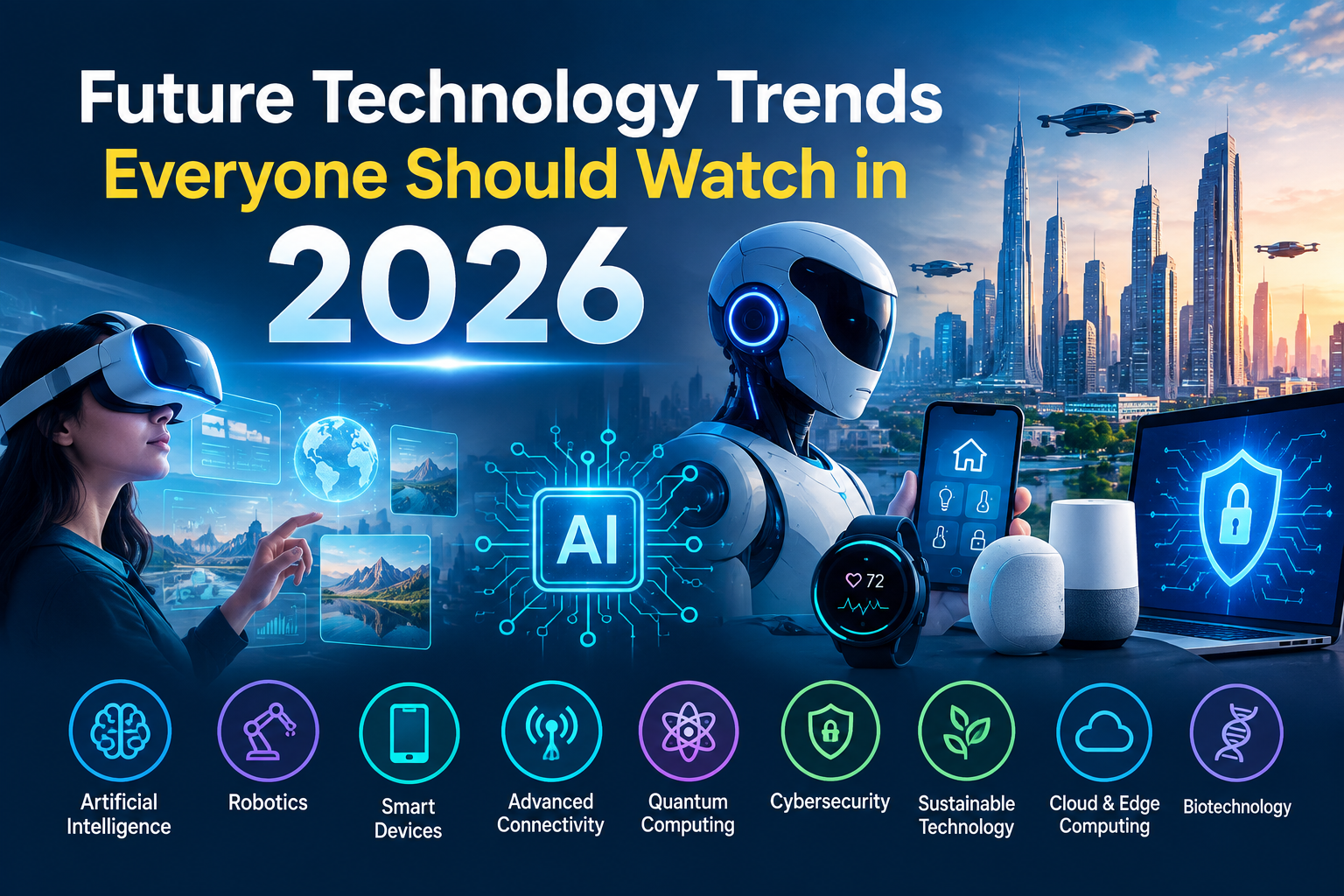
Technology continues to evolve at a remarkable pace, bringing new ideas, tools, and digital solutions into everyday life. From artificial intelligence and smart devices to advanced connectivity, emerging technologies are changing the way people work, communicate, learn, and do business.
The technology landscape in 2026 is focused on smarter systems, faster performance, stronger security, and more personalized digital experiences. Understanding these future technology trends can help individuals and businesses prepare for the opportunities and changes ahead.
Read More: Most Anticipated Video Games Coming in 2026
Artificial Intelligence Becomes More Advanced
Artificial intelligence remains one of the biggest technology trends shaping 2026. Modern AI systems can understand text, images, audio, and complex data, making them useful across many industries. Businesses are using AI for customer support, content creation, data analysis, automation, and decision-making.
AI-powered tools are also becoming easier for everyday users. Intelligent assistants, productivity platforms, search systems, and creative applications are helping people complete tasks faster. As AI continues to improve, its role in daily digital experiences is expected to become even more significant.
AI Agents Transform Digital Work
AI agents are emerging as an important development within artificial intelligence. Unlike traditional software tools that perform individual commands, AI agents can handle multiple steps toward a specific goal. They can organize information, analyze data, prepare documents, and support business workflows.
Companies are exploring AI agents for repetitive and time-consuming tasks. This trend could reshape workplace productivity by allowing employees to focus more on creative thinking, communication, and strategic responsibilities while intelligent systems manage routine processes.
Smart Devices Become More Connected
Smart technology is becoming increasingly common in homes, offices, vehicles, and public spaces. Connected devices can communicate with each other through modern networks, creating more convenient and automated environments.
Smart appliances, wearable devices, security systems, and connected vehicles are becoming more intelligent. Better sensors and AI integration allow these devices to respond to user behavior and changing conditions, creating more personalized digital experiences.
5G and Next-Generation Connectivity
Fast and reliable connectivity remains essential for modern technology. 5G networks are supporting applications that require high speeds and low latency, including connected vehicles, cloud services, industrial automation, and immersive digital experiences.
The development of advanced wireless technologies will continue supporting connected environments. Faster networks can help businesses process information quickly while giving consumers smoother experiences across mobile devices, smart products, and online services.
Quantum Computing Gains Attention
Quantum computing represents a major area of research within advanced technology. Unlike conventional computers, quantum systems use quantum principles to process certain types of complex problems in fundamentally different ways.
Quantum computing is still developing, but researchers and technology companies are exploring applications in areas such as scientific research, optimization, materials development, and cryptography. Progress in this field could eventually create new possibilities for solving problems that are difficult for traditional computers.
Extended Reality Creates New Digital Experiences
Virtual reality, augmented reality, and mixed reality are continuing to develop. These technologies combine digital content with immersive environments, creating new ways to interact with information and entertainment.
Businesses are exploring extended reality for training, product demonstrations, education, design, healthcare, and collaboration. Improved hardware and software could make immersive experiences more comfortable, accessible, and practical for a wider range of users.
Cybersecurity Becomes More Important
As digital services expand, cybersecurity is becoming a critical technology priority. Businesses and individuals face growing risks from phishing, malware, data breaches, identity theft, and other online threats.
Artificial intelligence is being used on both sides of the cybersecurity landscape. Security teams can use AI to identify unusual activity and detect potential threats, while attackers may also use automated tools for sophisticated attacks. Strong authentication, secure software, regular updates, and cybersecurity awareness will remain essential.
Sustainable Technology Continues Growing
Environmental concerns are influencing the development of new technologies. Companies are investing in energy-efficient hardware, renewable energy systems, electric transportation, smart buildings, and improved battery technology.
Sustainable technology aims to reduce resource consumption while maintaining performance and reliability. Advances in energy storage, efficient computing, and intelligent power management could support cleaner and more efficient digital infrastructure.
Robotics Expands Beyond Industrial Use
Robotics is moving beyond traditional manufacturing environments. Modern robots are being developed for logistics, healthcare, agriculture, retail, transportation, and other applications.
AI is making robots more adaptable by helping them understand environments and respond to changing situations. As sensors, software, and hardware improve, robots may become increasingly useful for repetitive physical tasks and specialized operations.
Cloud Computing Evolves With Edge Technology
Cloud computing continues to provide businesses with flexible access to storage, software, and computing resources. However, many applications also require information to be processed closer to where data is generated.
Edge computing addresses this need by processing data near devices and users instead of sending everything to distant data centers. This approach can support applications requiring fast responses, including smart factories, connected vehicles, healthcare devices, and real-time monitoring systems.
Biotechnology Meets Digital Innovation
Technology is also transforming healthcare and life sciences. AI-powered analysis, advanced medical imaging, digital health platforms, wearable sensors, and computational biology are creating new opportunities for research and personalized services.
The combination of computing power and biotechnology can help researchers analyze large datasets and explore complex biological processes. These developments could influence future approaches to medical research, diagnostics, and treatment development.
Key Technology Trends to Watch
Several developments are expected to remain important throughout 2026:
- Artificial intelligence and autonomous AI agents
- Smart devices and advanced connectivity
- Quantum computing and cybersecurity
- Robotics, cloud computing, and edge technology
These trends are not developing independently. Many are becoming interconnected, with AI powering smart devices, robotics, cybersecurity platforms, cloud services, and other emerging technologies.
What These Trends Mean for Businesses
Businesses are increasingly adopting technology to improve efficiency, understand customers, reduce operational costs, and create new digital products. Companies that monitor emerging technologies can identify useful opportunities while preparing for potential challenges.
Technology adoption also requires careful planning. Businesses need to consider cybersecurity, employee skills, data privacy, infrastructure, and long-term costs before introducing new systems. A practical technology strategy can help organizations benefit from innovation without creating unnecessary complexity.
The Future of Technology in 2026
The future technology landscape is becoming more intelligent, connected, automated, and data-driven. Artificial intelligence is influencing many areas, while developments in robotics, quantum computing, connectivity, cybersecurity, and sustainable technology are expanding the possibilities of digital innovation.
For individuals and businesses, staying informed about these trends can make it easier to understand the changing digital environment. Technology will continue evolving throughout 2026, creating new opportunities while introducing challenges that require thoughtful planning and responsible adoption
Frequently Asked Questions
What is the biggest technology trend in 2026?
Artificial intelligence is one of the major technology trends in 2026, with growing use across business, education, healthcare, and everyday digital services.
How is AI changing technology in 2026?
AI is improving automation, data analysis, digital assistants, content creation, cybersecurity, and personalized user experiences.
Will quantum computing become important in 2026?
Quantum computing remains an emerging field, with ongoing research focused on solving complex problems beyond the practical reach of conventional computers.
What role will smart devices play in 2026?
Smart devices will become more connected and intelligent, helping users automate tasks, monitor information, and create personalized digital experiences.
Why is cybersecurity important in 2026?
The growing use of digital services increases security risks, making strong cybersecurity essential for protecting personal information, business systems, and online accounts.
What is the future of robotics in 2026?
Robotics is expanding into industries such as healthcare, logistics, agriculture, manufacturing, and retail through improved AI, sensors, and automation.
Why should businesses follow future technology trends?
Following emerging technology helps businesses identify new opportunities, improve efficiency, strengthen digital operations, and prepare for changing customer needs.
Conclusion
Future technology trends in 2026 are shaping a digital world built around intelligence, connectivity, automation, security, and sustainability. AI, smart devices, robotics, quantum computing, extended reality, and advanced networks are among the key developments worth watching.
As these technologies mature, their influence will extend across workplaces, businesses, education, entertainment, healthcare, and everyday life. Keeping up with emerging technology can help people understand the opportunities created by the next generation of digital innovation.

1 Comment
Pingback: Smart Technology Innovations Transforming Modern Living