

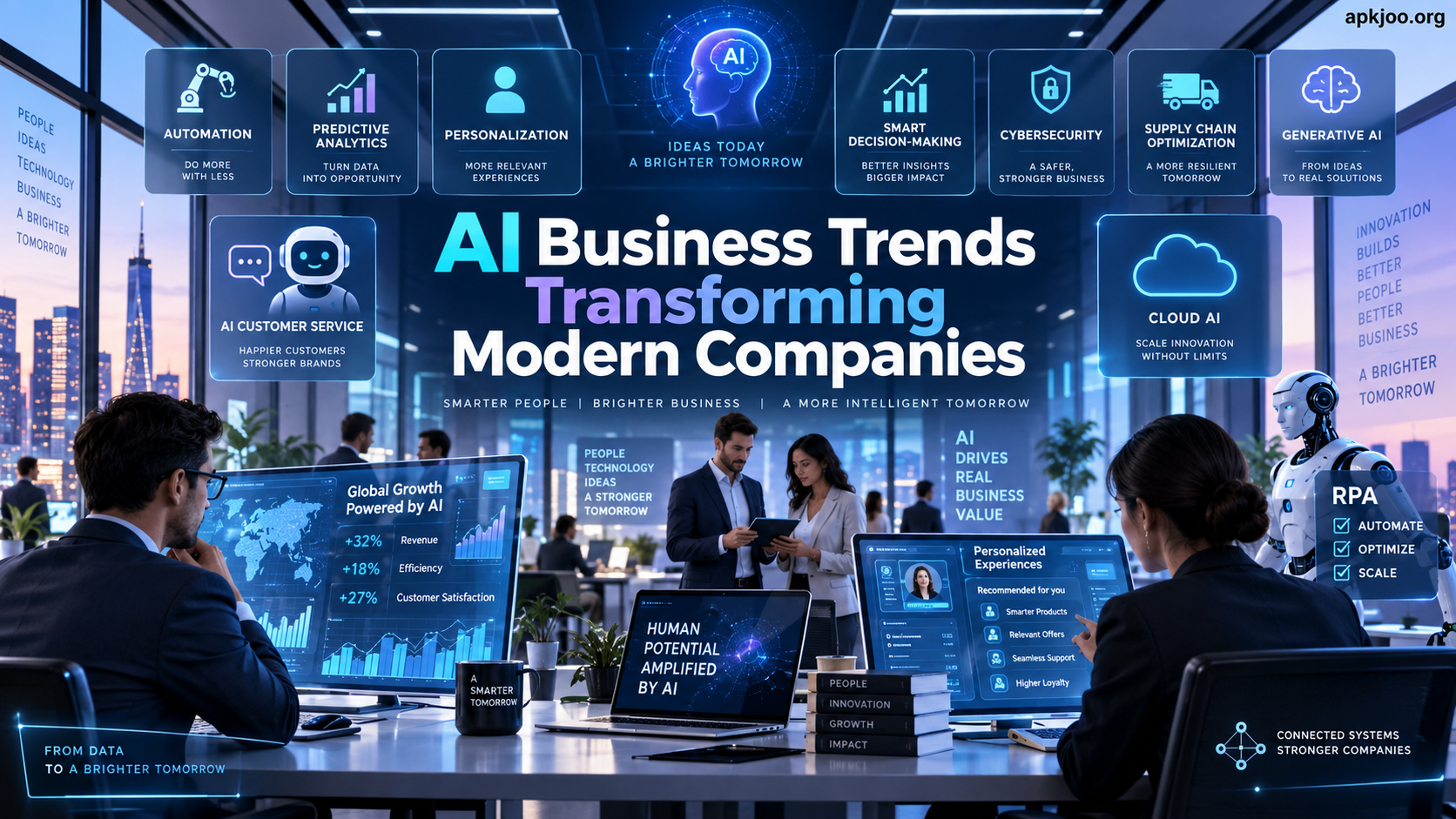
Artificial intelligence is rapidly changing the way modern companies operate, compete, and serve customers. Businesses across industries now use AI for automation, data analysis, customer support, marketing, cybersecurity, and strategic planning. These developments are helping companies improve efficiency while creating new opportunities for growth.
AI business trends are moving beyond simple automation. Modern organizations are combining intelligent tools with human expertise to make faster decisions, personalize customer experiences, reduce operational costs, and discover new revenue opportunities. As AI technology continues evolving, its role in business is becoming more important than ever.
Read More: Top Gaming Trends Set to Dominate 2026
AI-Powered Business Automation
Business automation is one of the biggest AI trends transforming modern companies. Intelligent systems can handle repetitive tasks such as data entry, document processing, scheduling, reporting, and basic customer inquiries. This allows employees to focus on creative and strategic responsibilities.
AI automation can also reduce manual errors and improve workflow efficiency. Companies can connect AI tools with existing business platforms to streamline daily operations and create smoother processes across different departments.
Smarter Data Analysis and Decision-Making
Modern businesses generate huge amounts of data from customers, websites, applications, sales channels, and internal operations. AI helps companies analyze this information quickly and identify valuable patterns.
AI-powered analytics can support forecasting, customer research, sales planning, and performance monitoring. Business leaders can use these insights to make informed decisions based on real-time information rather than relying only on assumptions.
Personalized Customer Experiences
Customer expectations are becoming increasingly personalized. AI allows businesses to understand customer behavior and deliver more relevant experiences across websites, applications, email campaigns, and digital platforms.
Recommendation systems can suggest products based on previous activity, while AI-powered customer service tools can provide quick responses to common questions. Personalized experiences can help businesses build stronger customer relationships and improve engagement.
AI-Powered Marketing Strategies
Artificial intelligence is also transforming digital marketing. Businesses can use AI to analyze audience behavior, identify customer interests, create content ideas, and optimize marketing campaigns.
AI tools can help marketers discover trends and understand which strategies generate better engagement. Automated campaign analysis also makes it easier to adjust marketing efforts based on changing customer behavior.
Generative AI for Business Content
Generative AI has become an important business technology for creating and improving digital content. Companies can use AI systems to assist with blog posts, product descriptions, social media content, reports, presentations, and marketing materials.
Human review remains important for maintaining accuracy, originality, brand identity, and quality. The strongest approach combines AI efficiency with human creativity and professional judgment.
AI in Cybersecurity
Cybersecurity has become a major priority for modern organizations. AI can help businesses detect unusual activity, identify potential threats, monitor networks, and respond to suspicious behavior.
Intelligent security systems can analyze large volumes of information much faster than traditional manual processes. This makes AI valuable for organizations looking to strengthen digital security and protect sensitive business information.
AI-Driven Predictive Analytics
Predictive analytics is another important AI business trend. Companies can use historical and real-time data to identify possible future outcomes.
Retail businesses may use predictive systems to estimate demand, while manufacturers can monitor equipment data to identify potential maintenance issues. Financial organizations can analyze patterns related to risk and customer activity. These applications help companies prepare for changing market conditions.
AI-Powered Customer Support
Customer support is experiencing major changes through AI-powered chatbots and virtual assistants. These systems can answer common questions, provide basic guidance, and help customers find information quickly.
AI support tools can operate around the clock, reducing waiting times for customers. Human agents can then handle complex cases that require detailed understanding, empathy, or specialized knowledge.
AI for Workforce Productivity
AI is increasingly becoming a productivity partner for employees. Intelligent tools can summarize information, organize tasks, analyze documents, generate ideas, and assist with communication.
Instead of replacing every human task, many companies are using AI to support employees and reduce repetitive workloads. This approach can help teams spend more time on problem-solving, innovation, and customer-focused activities.
Key Benefits of AI for Modern Companies
AI adoption can provide several important advantages for organizations:
- Faster business processes and improved productivity
- Better data-driven decision-making
- More personalized customer experiences
- Reduced repetitive workload and operational costs
- Improved cybersecurity and risk monitoring
Challenges of AI Adoption
Despite its benefits, AI adoption also creates challenges. Businesses need reliable data, appropriate technology infrastructure, skilled employees, and clear AI governance policies.
Privacy and security are also important considerations. Companies should carefully manage sensitive information and establish clear rules for responsible AI usage. Human oversight remains essential when AI systems influence important business decisions.
The Future of AI in Business
AI business trends will continue developing as companies discover new ways to integrate intelligent technologies into their operations. Future systems are likely to become more connected, personalized, and capable of supporting complex business activities.
Organizations that approach AI strategically can create stronger workflows while maintaining human oversight. Successful AI adoption will depend not only on technology but also on employee skills, responsible implementation, quality data, and clear business objectives.
Frequently Asked Questions
What are AI business trends?
AI business trends include automation, predictive analytics, generative AI, personalized marketing, smart customer support, and AI-powered cybersecurity.
How is AI transforming modern companies?
AI helps companies automate repetitive tasks, analyze data, improve customer experiences, reduce costs, and support faster business decisions.
Can AI improve business productivity?
Yes. AI can handle repetitive work, organize information, assist employees, and streamline business processes, allowing teams to focus on higher-value tasks.
How does AI improve customer service?
AI-powered chatbots and virtual assistants provide fast responses to common questions and offer support around the clock.
Is AI useful for small businesses?
Yes. Small businesses can use AI for marketing, customer support, data analysis, content creation, and workflow automation.
What is the future of AI in business?
AI will continue becoming more integrated into business operations, with greater use of automation, predictive analytics, personalization, and intelligent decision-making.
Conclusion
AI is transforming modern companies through automation, intelligent analytics, personalized experiences, cybersecurity, predictive insights, and employee productivity. Businesses that understand these developments can identify practical opportunities for improving their operations and customer services.
The future of business will increasingly combine artificial intelligence with human creativity and expertise. Companies that focus on responsible and useful AI adoption can build efficient processes, make smarter decisions, and remain adaptable in an increasingly digital marketplace.

1 Comment
Pingback: 10 Emerging Technologies Set to Shape the Future