
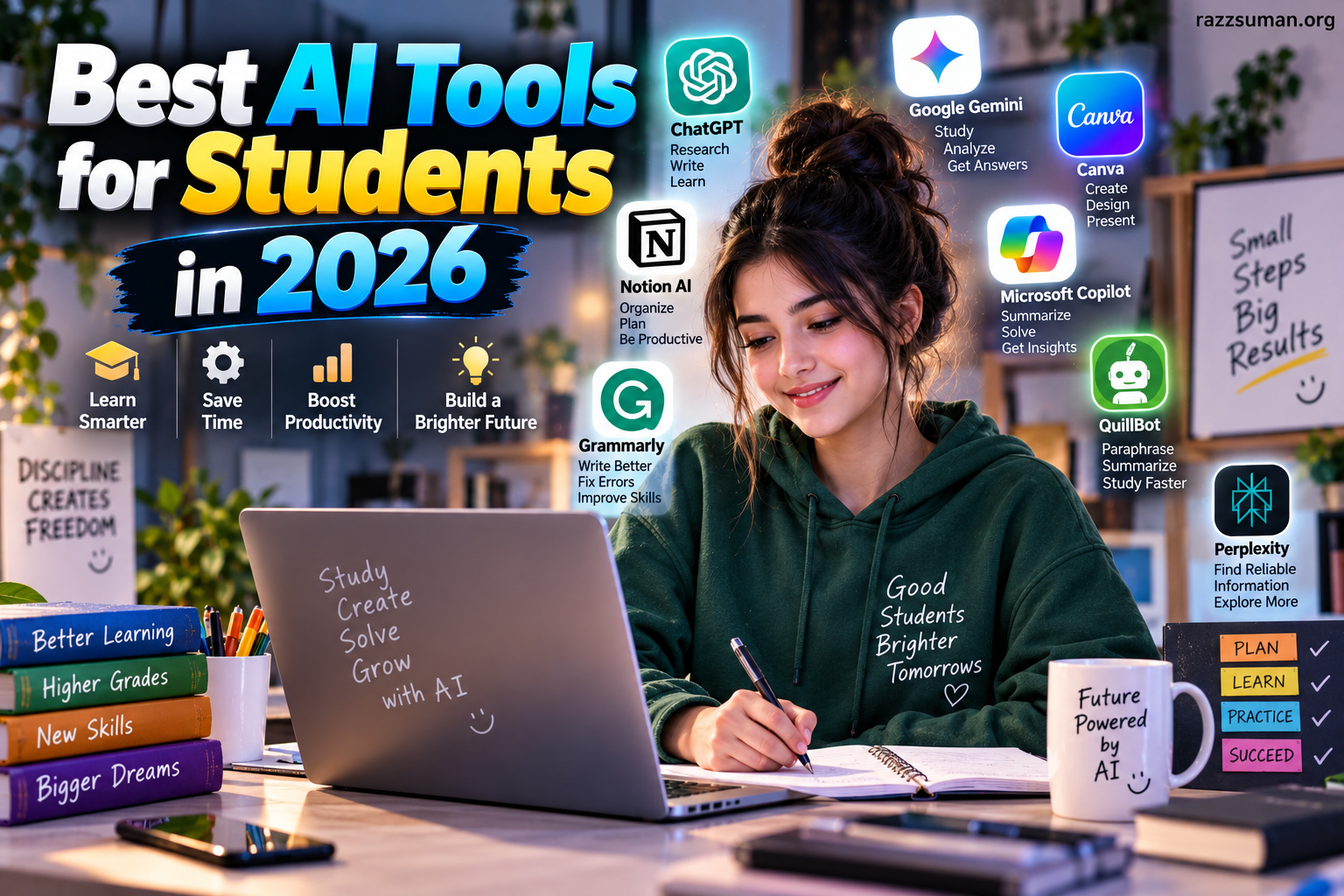
Artificial intelligence has become a useful part of modern education. In 2026, students can use AI tools for research, writing, note-taking, studying, presentations, coding, and daily academic tasks. These tools can reduce repetitive work and help students understand difficult subjects faster.
The best AI tools for students are not designed to replace learning. They work as digital study assistants that support research, improve productivity, organize information, and explain complex ideas in simple language. Choosing the right tool depends on a student’s subject, study style, and academic needs.
Read More: Top Education Technology Trends Shaping 2026
AI Tools Making Student Life Easier
Students often manage assignments, exams, projects, research papers, and presentations at the same time. AI tools can simplify many of these responsibilities by providing quick assistance and organized workflows.
Modern AI platforms can summarize long material, create study notes, generate practice questions, explain difficult concepts, and help students organize their ideas. This makes AI especially useful for students who want a more efficient study routine.
- Research and information gathering
- Writing and editing support
- Study planning and revision
AI Writing Tools for Students
Writing remains an important part of academic life. AI writing tools can help students develop ideas, improve sentence structure, check grammar, and make their writing clearer. These features are useful for essays, reports, presentations, and project documentation.
Students should use writing assistants as editing and learning tools rather than submitting AI-generated content without review. Personal research, original ideas, and proper citations remain essential for quality academic work.
AI writing platforms can also help students understand better writing techniques. They can identify unclear sentences, suggest alternative wording, and highlight areas that need improvement.
AI Research Tools for Academic Work
Research can take considerable time, especially when students need to review multiple sources. AI research tools can help organize information and identify important points from large amounts of material.
Some platforms provide summaries, source-based answers, and research assistance. Students can use these features to create an initial understanding of a topic before reading reliable sources in greater detail.
AI research tools can be particularly useful for:
- Finding relevant research topics
- Summarizing academic material
- Organizing research ideas
- Understanding complex information
AI Study Assistants and Homework Support
AI study assistants can provide explanations based on a student’s questions. Instead of simply giving an answer, many modern tools can break difficult subjects into smaller concepts.
For subjects such as mathematics, science, programming, and economics, this type of assistance can make challenging lessons easier to understand. Students can ask follow-up questions and explore a topic at their own pace.
The best results come when students attempt a problem first and use AI to identify mistakes or understand concepts they find difficult.
AI Tools for Note-Taking
Taking organized notes can improve revision and save valuable study time. AI-powered note-taking tools can summarize lectures, organize information, and turn lengthy material into easier-to-review sections.
Students can use AI summaries alongside their original notes. Reviewing the source material remains important because automated summaries can sometimes miss context or important details.
AI note-taking is especially helpful during research projects and revision periods when students need to manage large amounts of information.
AI Tools for Presentations
Presentations are common in schools, colleges, and universities. AI presentation tools can help students transform ideas into structured slides, suggest layouts, and create visual content.
Students can begin with a topic and use AI to develop an outline. Afterward, they can customize the presentation with their own research, examples, images, and explanations.
A strong presentation still depends on accurate information and clear communication. AI should support the preparation process rather than replace the student’s understanding of the subject.
AI Tools for Coding Students
Programming students can benefit from AI coding assistants that explain code, identify errors, suggest solutions, and help with development tasks. These tools can make programming practice more interactive.
Beginners can ask an AI assistant to explain programming concepts in simple terms. More advanced students can use AI to review code, explore alternative approaches, and troubleshoot errors.
Students should understand the code they use. Copying AI-generated code without learning how it works can create problems during exams, technical interviews, and real-world projects.
AI Tools for Language Learning
AI has also changed language education. Students can practice vocabulary, grammar, pronunciation, conversation, and writing with AI-powered learning platforms.
AI tutors can provide instant feedback and create personalized exercises based on a student’s current level. This makes language practice more flexible because students can study whenever they have free time.
Regular practice remains important. AI becomes more useful when students actively participate instead of relying on automated translations or answers.
Benefits of AI Tools for Students
AI tools can provide several practical benefits when used responsibly. They can reduce repetitive tasks and give students more time to focus on learning and creative work.
Personalized explanations are another major advantage. A student can ask the same question in different ways until the concept becomes clear.
- Faster research and information organization
- Personalized explanations and practice
- Better writing and productivity
- Support for difficult academic subjects
- Easier organization of study material
Responsible Use of AI in Education
AI can support education, but students should understand its limitations. AI-generated information may contain errors, outdated details, or misleading explanations. Important academic information should always be checked against trustworthy sources.
Academic integrity also matters. Schools and universities may have different rules regarding AI-generated content. Students should follow their institution’s policies and disclose AI assistance when required.
The goal should be learning rather than simply completing assignments faster. Using AI to understand concepts, improve skills, and review work creates more long-term value.
Choosing the Right AI Tool
Every student has different academic requirements. A research student may need an AI research assistant, while a programming student may benefit more from an AI coding platform. A language learner may prefer an AI conversation tutor.
Before choosing a tool, students should consider accuracy, privacy, available features, pricing, ease of use, and compatibility with their study requirements.
It is also useful to compare several tools before committing to one platform. Free versions can help students understand whether a tool fits their workflow.
Future of AI Tools for Students
AI education technology is expected to become more personalized throughout 2026 and beyond. AI systems are increasingly capable of adapting explanations, generating practice activities, and supporting different learning styles.
Future student tools may combine research, tutoring, planning, writing assistance, and progress tracking within unified platforms. This could create more personalized learning experiences for students across different education levels.
Human guidance will remain important. Teachers provide context, mentorship, judgment, and personal support that automated systems cannot fully replace.
Frequently Asked Questions
What are the best AI tools for students in 2026?
AI writing assistants, research tools, study tutors, note-taking platforms, coding assistants, and language-learning tools are useful for students in 2026.
Can AI tools help students with homework?
Yes. AI tools can explain concepts, solve practice problems, provide examples, and help students understand difficult homework topics.
Are AI tools useful for academic research?
Yes. AI research tools can help summarize information, organize ideas, discover relevant topics, and support the early stages of academic research.
Can students use AI for essay writing?
Students can use AI for brainstorming, grammar checking, editing, and improving clarity. Original research and ideas should remain the student’s own.
Are AI coding tools helpful for programming students?
Yes. AI coding assistants can explain code, identify errors, suggest solutions, and help students understand programming concepts.
Can AI improve student productivity?
AI can help students organize notes, plan study sessions, summarize material, create outlines, and manage repetitive academic tasks.
Are AI tools safe for students?
Students should review privacy policies and avoid sharing sensitive personal or academic information. AI-generated information should also be verified.
Will AI replace teachers in the future?
AI can support learning, but teachers provide mentorship, classroom interaction, feedback, and guidance that AI cannot fully replace.
Conclusion
The best AI tools for students in 2026 can make studying more organized, productive, and interactive. Research assistants, writing tools, study platforms, note-taking systems, presentation generators, coding assistants, and language-learning tools all offer different advantages.
Students can gain the most value by using AI as a learning partner rather than a replacement for their own effort. Combining AI assistance with original thinking, reliable research, critical evaluation, and consistent practice can create a stronger academic experience.

1 Comment
Pingback: 10 Must-Have Android Apps Worth Trying in 2026